SKU: 34990509438
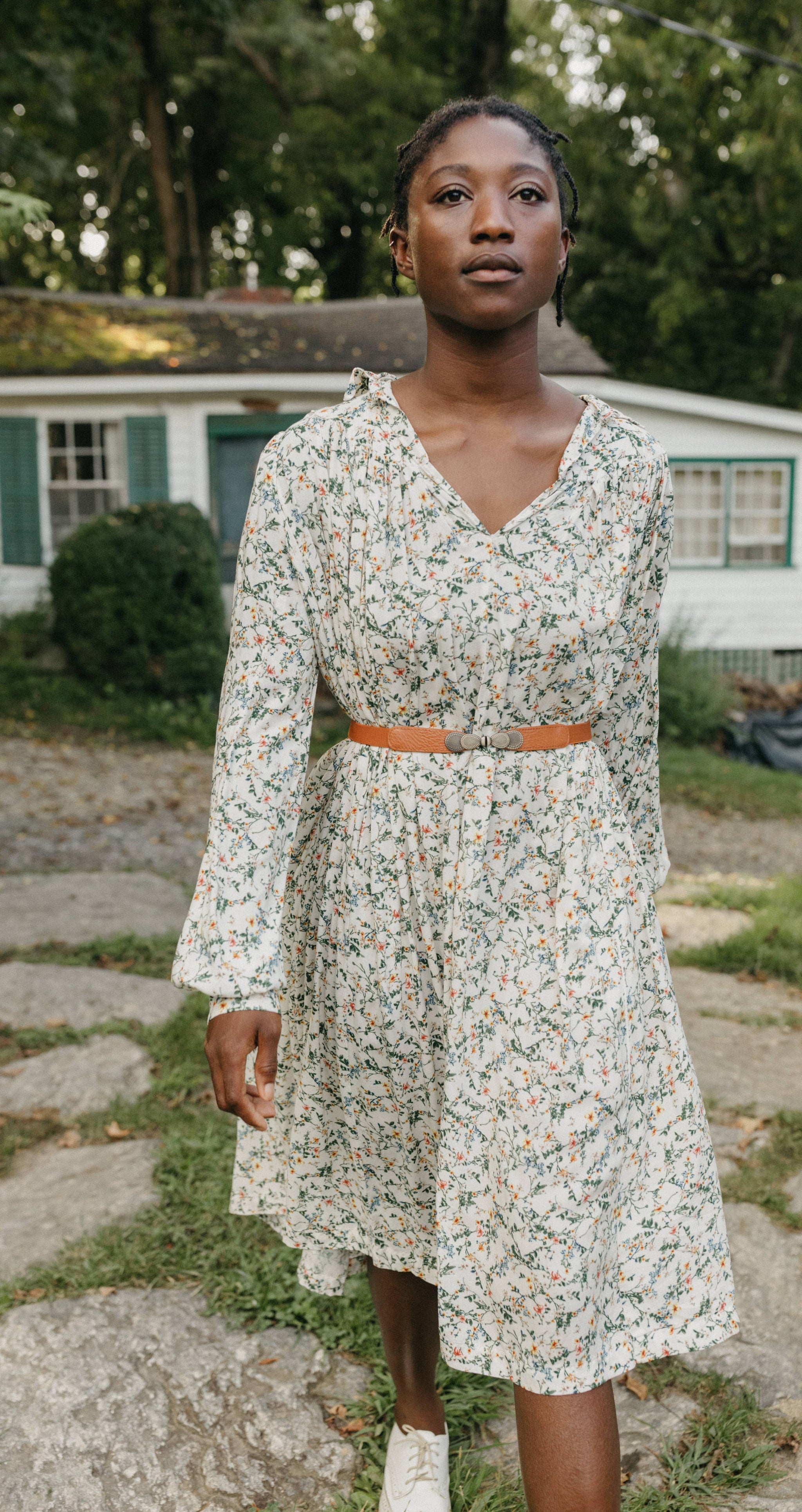
women's prairie dress

women's prairie dress 201 Prairie Dress

Sale price$24.20 Regular price$26.89
Save 10%
Size: 4

Shipping Estimate
USA
  • USA
  • CAN

Ships within 48 hours · Estimated delivery Jul 13 - Jul 18

Promo Codes Available:

For Your Every Summer RSVP, with Code: SUMMER15

Description

women's prairie dress 201 Prairie DressSizes XS 3XL The stalwart women who braved the 19th century American prairie wore full yet practical housedresses of washable cotton. This flowing dress was traditionally worn with a practical apron. Ours falls to the ankles in voluminous gathers from a gracefully rounded yoke. It has long sleeves gathered at the shoulders and into buttoned cuffs. The ruffled collar is set into a collar band, and the dress has pockets set into both side seams. The

Sizes XS-3XL 

The stalwart women who braved the 19th century American prairie wore full yet practical housedresses of washable cotton.  This flowing dress was traditionally worn with a practical apron.  Ours falls to the ankles in voluminous gathers from a gracefully rounded yoke.  It has long sleeves gathered at the shoulders and into buttoned cuffs.  The ruffled collar is set into a collar band, and the dress has pockets set into both side seams.  The deep front opening typical of this era closes with buttons in the yoke; hooks and eyes can be used to fasten the long opening.

The flounced apron has two keyhole pockets and a waistband that buttons in the back.  Instructions for decorative feather stitch are included inside pattern.  For contemporary wear, this dress is charming in the authentic version worn with or without the apron, mid-calf (cut to street length) or ankle length, the dress is feminine and comfortable. also, if you prefer, the front opening can be shortened, and the neck can be finished with the collar band only.  Instructions for vintage embroidered finishing touches are included.

Era: Victorian, mid to late 1800s

For children we have the 213 Child's Prairie Dress and Pinafore pattern.  

Suggested fabrics: For the Dress, choose soft fabrics such as calico, gingham, muslin, lightweight cotton, rayon, or wool challis. For the Apron, choose light or medium-weight cotton such as gingham, broadcloth, or muslin. 

Yardage chart (.pdf)

This pattern is available as a Paper pattern and PDF pattern.  Choose the pattern format you want in the drop down menu.  The PDF pattern has files for copy shop (36” and A0), print at home (A4 and 8.5”x11”), as well as sewing and detailing instructions.

LEARN MORE: 

Shipping Notes
  • Free Standard Shipping on $100+ Orders to the USA.
  • Except Preorder products are shipped in 48 hours.
  • Delivery to the USA:
  1. Standard Shipping : 3-10 business days
  • If time is of the essence, please consider selecting expedited delivery for faster service.
Exchange/Return Notes
  • We offer a 30-day return/exchange service after receiving.
  • Final sale items are not eligible for returns or exchanges.
  • To process your return/exchange, please contact us at [email protected]
  • Please click here for more details>>> Return & Exchange Policy
SKU: 34990509438

Discover Niche Categories That Outsell women's prairie dress

Top-Converting Item to Boost Your Average Order

4.9 ★★★★★
Based on 209 reviews
Sort
Highest Rating
Newest First
Oldest First
Product Reviews
A
Verified Purchase
A.
West Palm Beach, US
★★★★★ 4
Why do black people . . .
Format: Hardcover
I purchased this book because I had many questions I wanted answered. Most of them were questions of "Why?". My biggest question was why we as black people have so many unhealthy habits in how we treat each other. As a young African American male who was raised by his mother in a predominantly white suburban area, I wanted to know why, when I encountered other black youth in more urban areas, they would tell me I "talk white." What is "talking white?" Basically, talking white means I was talking like I have an education. Why do so many members of the black community (those without an education) reject me for valuing education? Why is it that when one black person fidns a way out of the ghetto, it seems the whole neighborhood, church included, condems that person for leaving "his/her people" and wanting to live in the suburbs with the whites? Why don't we support one-another in this society that has always held us from achieving our full potential? I wanted to learn why we seem to have no clue of who we are, and so many of us, young and old, strive to "prove" we are "black enough." So talking a certain way makes us black? Or is it eating certain foods that makes us "black"? Listening to only certain kinds of music? We lack a firm sense of cultural identity. We take rebellious pride in being at the bottom, and equate success with "whiteness." We denounce the achievements of any black person and ostracize him from the community. We work to pressure our own to stay at the bottom. In this very interesting book, the author, Dr. Joy Degruy Leary, proposes a number of explanations for why the African American community has developed these and other unhealthy cultural habits. Leary examines this very real "crabs in the barrel" mentality, as well as many other self-destructive habits which plague the black community. Leary establishes a diagnoses, and calls it Post-Traumatic Slave Syndrome. Leary presents a very strong argument that the behaviors are all symptoms that have been passed down through the generations of African American people from the dawn of the trans-atlantic slave trade to today. Leary uses her own observations to support her theory of Post-Traumatic Slave Syndrome. This book is a very thoughtful read. The reason I give this work only four stars is because I truly feel that Leary's argument would have been much more affirmed and effective if she had included a visual timeline to help the reader to better understand the timeframes and chain of events in history discussed in the book. The argument also would have been more effective if the author spent more time on each point. At times it seems she's just getting started before summarizing all that was just said and moving on. Scholarly sources are cited and research is used, but the book does not explore any one study or statistic in great depth. It is a fast read.
WAS THIS REVIEW HELPFUL?YesReportShare
Reviewed in the United States on September 16, 2012
E
Verified Purchase
ez2laf
Charlottesville, US
★★★★★ 5
America's Biggest Lie
African Americans have been brutalized beyond imagination. Then told that they were the ones that were less than human. It boggles the mind. The whites beat, burned, skinned, lynched, mutilated and murdered African Americans at will. And these same whites believe (to this day) that this is their god given right. Even worst was the emotional and intellectual scars left from the lies that were told. If I didn't see the consequence of this everyday, I would think someone was lying to me: Some kind of Cosmic joke. The white criminals are the heroes and the African victims are the villains. This cannot actually be real. But it is. Whites stripped the Africans of their names, religions, dignity, culture and their humanity. Then called them less than human. This slight of hand is beyond comprehension. The funniest part is when I hear Whites yell to blacks "go back to Africa." This is tantamount to kidnapping someone, tying them up, putting them in your basement then yelling at them to get out of your house. Insane. This has been going on for 400 years. Wow. And America thinks it the moral leader of the free world. I have to pinch myself. This has to be a dream.... or a nightmare. The book opened my eyes.
WAS THIS REVIEW HELPFUL?YesReportShare
Reviewed in the United States on August 18, 2017
S
Verified Purchase
Sherri
Alexandria, US
★★★★★ 5
I have to step up as a parent..
Format: Hardcover
The book is a little bigger than what I realized. I must not have paid a attention to that because I did a quick buy. But thats not a bad thing it is a really nice coffee table book the pictures are great. I skimmed the book and it has some wonderful information. I wanted to have something to catch the attention of my GenAlpha son so he can learn about our history the school did a horrible job this year with learning Black history which is American history. Plan to get the study guide to help me talk about this with my son. Given the time we are living in I need to do better with informing and guiding him with facts. Because of my school and parents I learned a some of this growing up but the schools are barely teaching anything past MLK, Malcolm X or Harriet Tubman!
WAS THIS REVIEW HELPFUL?YesReportShare
Reviewed in the United States on April 29, 2026
B
Verified Purchase
2BMSALG😎😎😎
Lowell, US
★★★★★ 5
Must have👏🏾👏🏾👏🏾👏🏾
Format: Hardcover
Excellent hardcover and a must to a collection of history that many may not know. Take the journey that many will never understand 👏🏾💜🙌🏾
WAS THIS REVIEW HELPFUL?YesReportShare
Reviewed in the United States on April 28, 2026
D
Verified Purchase
Dglana
Fort Morgan, US
★★★★★ 5
a beautiful important history book
Format: Hardcover
What an amazing book! This book is the version with incredible photos as part of the history story. I couldn't believe how vivid this was when I opened up the book. I'd been wanting the book for a while, because so little is told of the enslaved people's history in this country. It is important for us to understand our past, and without books like this one we do not have the full story. Thank you to the authors who put together this beautiful book.
WAS THIS REVIEW HELPFUL?YesReportShare
Reviewed in the United States on October 22, 2025

recommand products